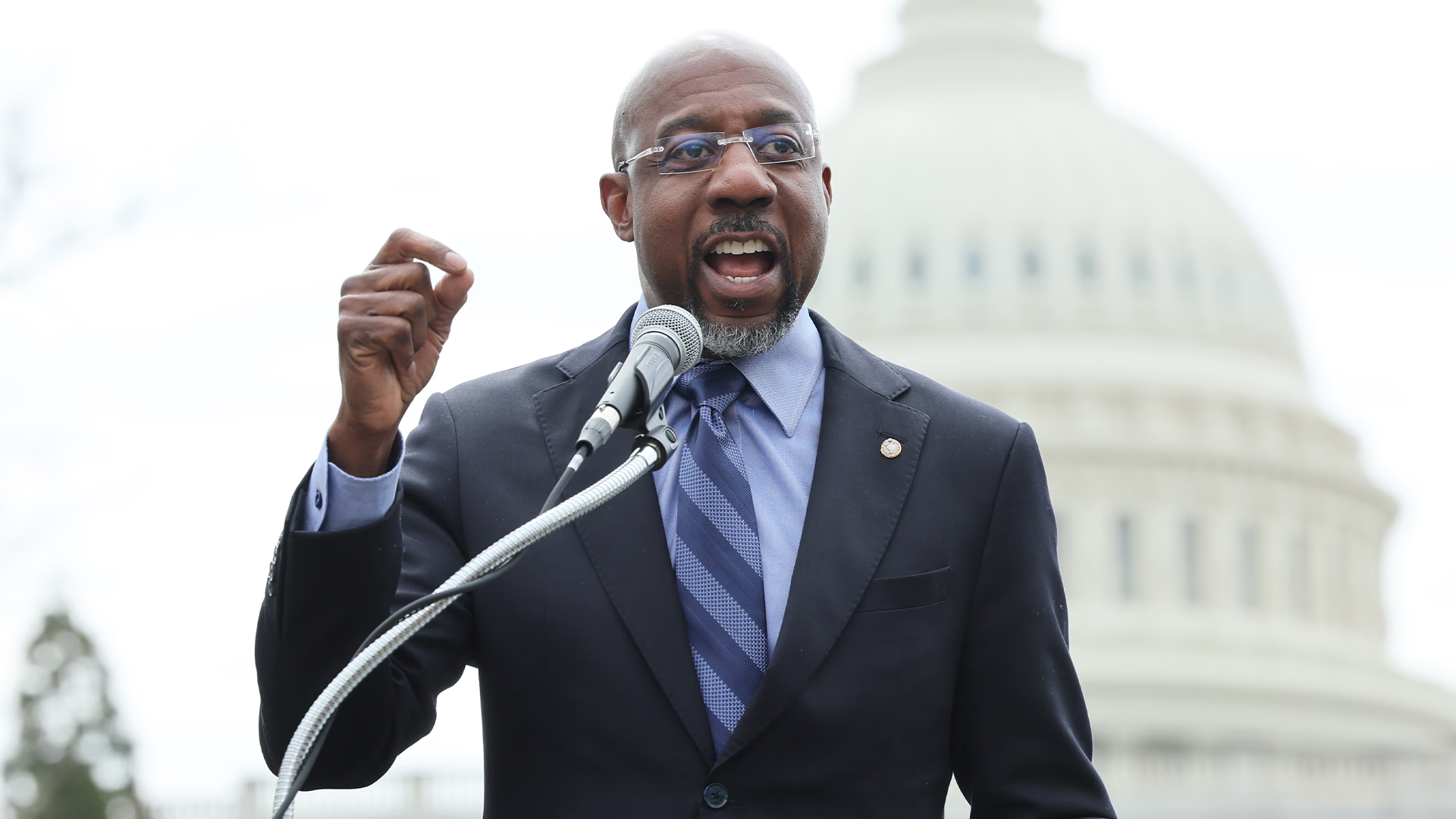
Ten historically Black colleges and universities will share $97.1 million in Department of Defense grants to expand science, technology, engineering and mathematics research, U.S. Sen. Raphael Warnock, D-Ga., announced in early October.
The awards come through the Pentagon’s HBCU/Minority-Serving Institutions program and range from roughly $7.6 million to $10 million per campus. Florida A&M University, Morgan State University and North Carolina A&T State University each received the maximum $10 million, while Jackson State University’s $7.57 million was the smallest share.
Warnock’s office said the money is intended to help the 10 institutions pursue R1 status, the top tier of the Carnegie Classification for research universities. Howard University remains the only HBCU to hold that designation.
“For too long, HBCUs have gone unrecognized for their contributions to our nation’s leading STEM industry,” Warnock said. “These institutions serve as stewards of academic excellence and innovation, and this federal investment specifically in STEM programs honors that legacy of greatness and expands opportunity for the next generation of scientists.”
Clark Atlanta University, the lone Georgia recipient, will receive $9.78 million over five years. The Atlanta school has said the grant will underwrite an initiative called Strengthening Participation & Academic and Research Capacity (SPARC) in STEM, centered on applied artificial intelligence and supporting its chemistry, cyber-physical systems, mathematics and physics departments.
“This significant investment strengthens Clark Atlanta University’s research enterprise while expanding opportunities for our faculty and students in some of the nation’s most important emerging technology fields,” CAU President George T. French Jr. said when the university disclosed the award in September.
Fayetteville State University in North Carolina, which received $9.9 million, plans to use its share to launch a doctoral program in defense-focused artificial intelligence.
The announcement follows Warnock’s push for the HBCU Research Capacity Act, a bipartisan measure he introduced March 24 with Sen. Katie Britt, R-Ala. The legislation would amend the Higher Education Act to direct the Secretary of Education, working with agencies including Defense, Energy, Commerce, NASA and the National Science Foundation, to build a centralized website listing research grants open to HBCUs. More than 30 HBCU presidents attended a Capitol roundtable marking the bill’s introduction.
Warnock, a Morehouse College graduate and the only HBCU alumnus currently in the Senate, said his office has secured more than $17 billion for HBCUs nationally since he won a full term in 2022, including nearly $275 million for institutions in Georgia.