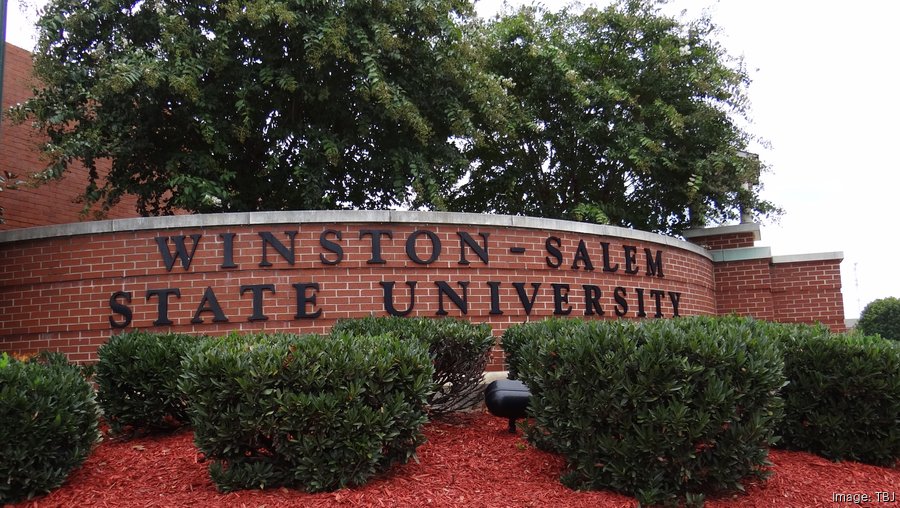
Winston-Salem State University has won a $496,376 grant from the National Science Foundation to prepare students outside of traditional tech fields to recognize and respond to cybersecurity threats involving artificial intelligence.
The three-year award, which runs through August 2029, will fund four teaching units on AI security. The units will be built into five courses WSSU students already take in healthcare management, education and computer science.
“There’s no question our students are using AI tools and will when they enter the workforce,” said Dr. Debzani Deb, the RJ Reynolds Endowed Professor of Computer Science, founding director of WSSU’s Center for Applied Data Science and the grant’s principal investigator. “But do they know when it is not working as expected, when it’s giving a biased decision or when it’s preferring one population over the other? Do they know what the law requires? That is my motivation.”
The curriculum will address four areas: how AI systems can fail or be attacked; how to assess an AI tool before adopting it; how to respond when an AI system causes harm or triggers a data breach under federal privacy laws such as HIPAA and FERPA; and the legal and ethical obligations that govern AI use in public-sector settings.
Because the units slot into existing courses, the project requires no new degree programs or added institutional resources. Each unit will come in both in-person and fully online formats to serve working professionals. The materials will also be made freely available to other colleges and universities and are designed for faculty with no prior background in AI security and for students who are not technology specialists.
Deb estimated the effort will reach 200 to 250 WSSU undergraduate and graduate students each year, based on enrollment in the participating programs.
Industry and community partners will supply real-world case studies so that course content mirrors situations graduates are likely to face on the job. Those partners include Novant Health, Atrium Health Wake Forest Baptist, Winston-Salem/Forsyth County Schools and Cisco.
Deb leads the project with three co-principal investigators: Dr. Muztaba Fuad, the Paul Fulton Endowed Professor and chair of the Department of Computer Science; Dr. Melissa Bowman Foster, a professor in the Department of Healthcare Management; and Dr. Dawn Hicks Tafari, an associate professor in the Department of Education. Dr. Tan Zhang, an assistant professor in health, physical education and sports studies, serves as the grant’s evaluator.
The team will select 10 additional WSSU faculty members through an application and interview process, and 10 professors from other University of North Carolina System campuses will also take part.
“AI is not a foolproof technology. It can make mistakes, and it is very easy to manipulate it,” Deb said. “I want Winston-Salem State University students to be informed and responsible users of AI tools.”
Dr. Shawn Holt, WSSU’s chief research officer and associate provost of research and innovation, said the award aligns with the first two pillars of Chancellor Bonita J. Brown’s strategic plan, “We Are Rising 2030”: fostering student success and advancing academic excellence.
“Dr. Deb’s AI Security Training and Workforce Development grant from the National Science Foundation is exactly the type of interdisciplinary research programming WSSU needs to educate the next generation,” Holt said.
The grant builds on a broader push at the historically Black university to engage with AI. Last month, WSSU held its inaugural RISE AI Summit at the Benton Convention Center, which drew more than 330 attendees and featured 41 presentations on AI’s expanding role in education, business and society. The keynote speaker was Dr. Siobahn Day Grady, a 2005 WSSU graduate who is an associate professor at North Carolina Central University and founding director of its Institute for Artificial Intelligence and Emerging Research, the first dedicated AI institute of its kind at an HBCU. University officials plan to make the summit an annual event. wssu
Deb said she expects the project’s impact to extend well beyond campus.
“Whenever our students go to work in hospitals or in public services, they will know how to spot an unsafe and unfair AI,” she said. “By doing that, they will protect the children or families that depend on them.”